TL;DR: In November 2026, AI agents stopped being a lab curiosity on the attacker side. Switzerland’s national cyber centre confirmed its first AI-agent intrusions, and every one it knows of succeeded. Google found a framework that turns patches into working exploits with no human involved. Amazon watched agents find a zero-day on their own. The practical upshot: your patch window and your secret hygiene now have to work at machine speed.
What happened this month
Several of the biggest names in threat intelligence published within days of each other, and they describe the same shift. Offensive AI agents (often called agentic offensive frameworks) are now used in real intrusions, not only in red-team demos. Here are the reports that matter, each linked to its primary source.
Switzerland: every known AI-agent attack succeeded
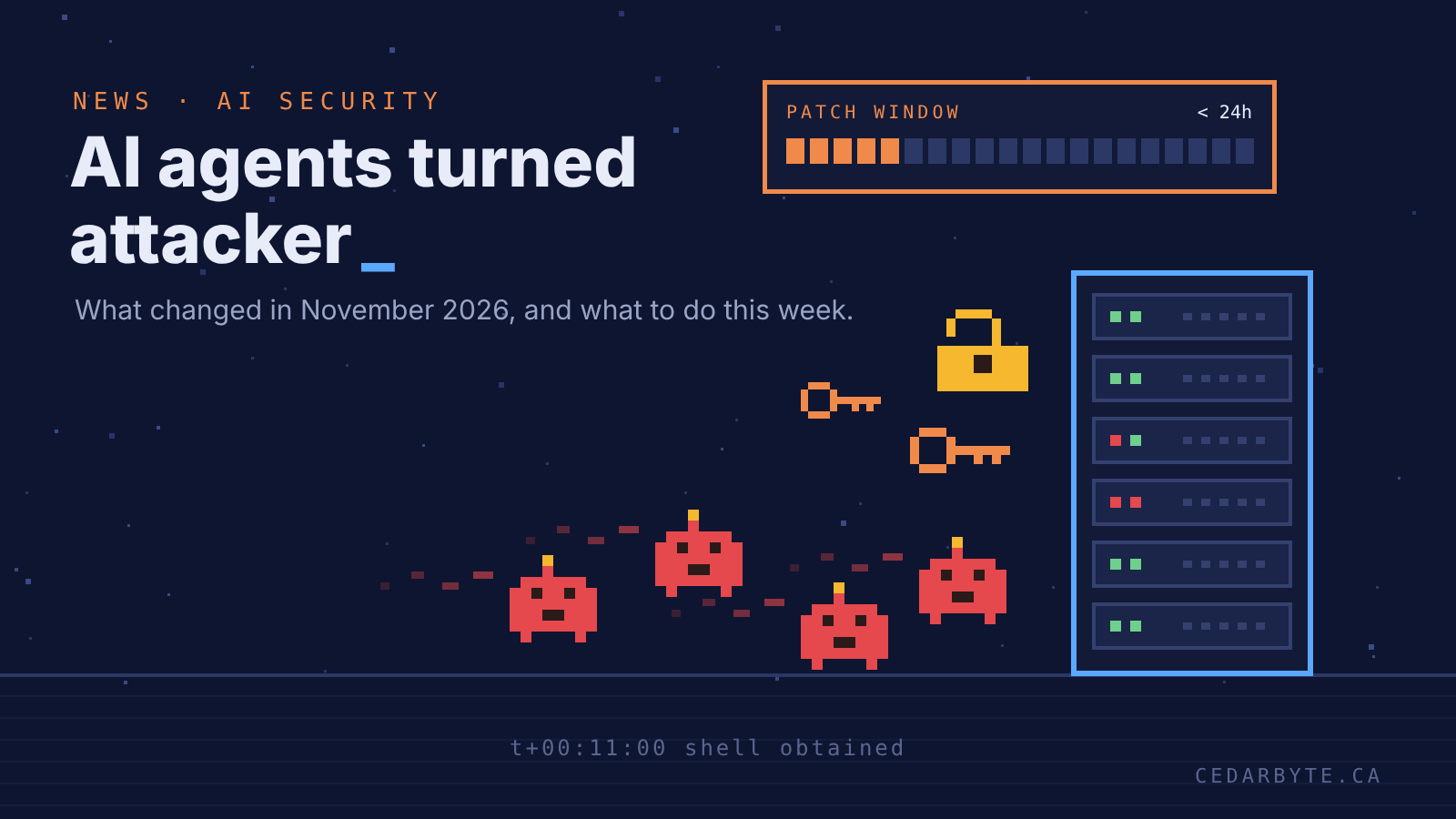
On 24 November the Swiss National Cyber Security Centre reported its first confirmed attacks carried out with the help of AI agents, against organisations and critical infrastructure operators in at least two sectors. In every case it knows of, the agents led to a successful compromise. It named the publicly available frameworks ARTEX and CyberStrikeAI as examples, and said the number of publicly reachable AI agents has nearly doubled since October. Its headline advice is blunt: install critical security updates on internet-facing systems no later than 24 hours after release.
Google: patch in, exploit out, no human in the loop
Google’s Threat Intelligence Group described a multi-agent framework it calls exploit_agent, found on an exposed staging server. It continuously compares popular web software before and after patches, works out what the patch fixed, drafts an exploit and runs it automatically. The server held data stolen from real victims, so this was operational, not a proof of concept. GTIG calls it the first time it has seen attackers fully automate discovery and exploitation with no human involved. The same report counts an average of 11 zero-day exploits a month in 2026 through August, up from 8 a month in 2025, with a spike to 22 in August.
Amazon: agents found a zero-day on their own
Amazon’s security team reported a China-nexus actor pointing agents from Cairn, an open-source autonomous pentesting framework, at a target with the plain-language goal “obtain shell access.” The agents found a path traversal flaw in the upload endpoint of MONAI Label, an open-source medical imaging AI application. About 11 minutes passed between the agents mapping the API and being able to write arbitrary files on the server. They then planted a reverse shell that ran as root. No advisory or fix existed at the time. Amazon notified the project’s maintainers, who published a critical advisory on 18 November covering version 0.8.5 and earlier. As of today the fix is merged but not yet in a release, and authentication is off by default. If you run MONAI Label, keep it off the internet until a patched version ships.
A separate Amazon report covers what its MadPot decoy sensors saw between 3 October and 5 November. Sensors posing as LLM inference APIs received requests from ARTEX agents that carried the agents’ own campaign records. The pattern was self-funding: the agents stole AI API keys, then fed them back into the framework to power the search for more keys.
Microsoft: from GitHub search to Key Vault in five minutes
Microsoft Threat Intelligence has watched ARTEX search public GitHub repositories since August for exposed credentials, app secrets and AI API keys, often pairing a target company’s name with secret-related keywords. In one case an agent went from searching GitHub for client secrets to pulling data out of Azure Key Vault in five minutes.
Drupal: found by an AI scanner, exploited a day after the fix
The defensive side of the same coin: Drupal’s highly critical installer flaw, SA-CORE-2026-017 (CVE-2026-132165), was found by Anthropic’s open-source scanner and published on 18 November. The Drupal security team received reports of exploitation on live sites from 19 November at 19:00 UTC. Fixed releases are 10.6.22, 11.3.22 and 11.4.13. End-of-life branches get no patch, so sites still on them need to lock down the installer path.
Why it matters
None of these attacks used a new class of vulnerability. Path traversal, leaked secrets, unpatched web apps: this is the same list defenders have worked through for twenty years. What changed is the clock.
The traditional assumption was that patch diffing and exploit writing took skilled humans days or weeks, which gave defenders a grace period after each release. Google’s findings remove that assumption, and its report says outright that n-day exploitation is now the faster path for attackers. A leaked secret used to sit unnoticed until a person happened to find it. Now an agent finds it, tests it and moves laterally before most alerting pipelines have produced a ticket.
There is a second, quieter trend. AI infrastructure itself is the target. Agents hunt for model API keys and exposed inference gateways because those keys convert directly into compute, and that compute pays for the next round of attacks.
What to do this week
The advice across all five reports converges. In rough priority order:
- Measure your patch time for internet-facing systems. If critical fixes on exposed services take more than a day, that is now the gap agents exploit. The Swiss target of 24 hours is a reasonable benchmark.
- Treat any secret that was ever public as compromised. Deleting a commit does not invalidate the key. Microsoft’s guidance is to rotate, then scan repositories and turn on push protection.
- Put AI endpoints under the same controls as production. Require authentication on inference endpoints and model gateways, remove default credentials, and alert on unexpected AI spend or usage spikes.
- Shrink what is reachable. Allow lists, geo-blocking and MFA or passkeys on everything internet-facing remove targets before an agent can enumerate them.
- Automate response for high-confidence detections. Amazon’s point is that agents exploit faster than analysts triage, so a human approving every containment step becomes the bottleneck. Keep people overseeing outcomes, not individual actions.
A useful detection lead
Automation leaves fingerprints. Wiz found that ARTEX and Cairn leak internal sub-goal counters (intent IDs in the form iNNNN) into names they create in victim environments, such as User-Agents, IAM session names and storage bucket names. ARTEX never resets its counter per installation, so a steadily climbing sequence across rotating IP addresses suggests a single operator. Wiz is careful to call this a corroborating signal rather than attribution, but it gives threat hunters something concrete to search for today.
FAQ
What is ARTEX?
ARTEX is an open-source agentic penetration testing framework. Like Cairn and CyberStrikeAI, it was built for legitimate testing, but Amazon, Microsoft and the Swiss NCSC have all reported malicious use of it, and Google has shipped detection rules for it.
Are AI agents finding new kinds of vulnerabilities?
Mostly no. The reported cases exploit familiar bug classes and leaked credentials. The difference is speed and scale, which is why patch time and secret hygiene matter more than exotic defences.
Should every AI-generated exploit claim be trusted?
No. Google notes that hundreds of non-working, LLM-generated proofs of concept followed one recent disclosure. Verify an exploit claim before reprioritising around it.
Every figure in this post is linked to the organisation that published it. All reports were checked on 27 November 2026. If a source is updated, this post will be too.